Day 3: Cottonwood Campground to North Rim Campground, May 14, 2025 (the day BEFORE the North Rim opened)
The morning view from my campsite:

Since temperatures were dropping to downright pleasant, I didn't worry about getting up really early, so I didn't get on the trail until about 7:50 AM--10 minutes behind the two older guys who'd arrived latish the night before and camped near me, but who I didn't get a chance to talk to. I thought, "I'll probably pass them on the trail soon." Joke was on me. Stay tuned for the rest of the story.
I also left about five minutes behind the big group I'd met the evening before. The trip leader was a father travelling with his adult daughter (so cool!) and five other people--his work friends and their partners. They were all super nice, and we leapfrogged all day, chatting and hanging out for bits and then separating and meeting up again later. All lovely people.
But those two older men...where were they?
About a mile north of Cottonwood is a gorgeous little waterfall down from the trail. I can't believe how beautiful this place is, and how varied. About there is where we started noticing pines. At a far lower elevation than I've noticed south of the river.

At Manzanita rest area, the water was on--but it was the last water we would have (water was still off at Supai Tunnel and North Rim trailhead, and there aren't any accessible streams), so we all hung out, filling up and chatting with three female trailrunners, one of whom was more advanced in age than I would believe for such a feat. Amazing. On my map app (the otherwise fantastic mapy.cz), there's a symbol for parking at Manzanita rest area, which always cracks me up. Because this is no parking lot you can drive your car to. It's a helicopter pad, mostly for emergencies, but I can just imagine someone less familiar with the canyon thinking it was a parking lot at the end of a road. Not so.
There was also a scale, so I weighed my pack. 28 lbs, loaded with over 4 liters of water (but minus my heavyish camera). Ultralight it's NOT, and I hope to get lighter as I get more experienced, but considering all that water, and the fact that most of my gear is on the budget side, I was pretty happy with that.

As I hiked, things just kept being so beautiful. I didn't hike fast. I just enjoyed the day--and took a million pictures. A funny thing about the Canyon: I'm old-fashioned and still generally prefer landscape photos that look best on a TV/laptop as opposed to portrait photos that look best on some social media platforms. But this is a place where it's hard to get the sky and everything else in the frame unless you go vertical.
From the North Kaibab Trail, the old Bright Angel Trail across the way looked quite precarious in parts, and I wondered if my trail looked just as precarious from that angle. There WERE a few parts later that day that made me...wary. I have a well-developed fear of heights, and I suspect that had I been hiking in deep snow or heavy rain or ice or high winds--like the wind two days ago--I would have been really nervous.

When Roaring Springs roared into view, I was amazed. The waterfall is huge for a place this generally arid. The power of that crashing water carried over the space between us. Amazing. I met a guy hiking down and asked him to take my picture. Turns out he was a North Rim employee, on his day off before the big opening. We chatted for a bit, swapping interesting stories.


I took the detour to Roaring Springs (the trail is open to the rest area--which heads away from the waterfall, not toward it, but the restroom is closed). No one else was down there but me and a whole lot of butterflies and dragonflies. I had a snack and a break and just watched all the life around me.

I met a ranger on the trail, headed down to turn the water on at Cottonwood, spend the night at Manzanita, and then hike over to the South Rim. What a terrible job he has. :)
The weather was gorgeous and I felt like my seven trail friends and I had the entire canyon to ourselves. Well, the eight of us, a few North Rim employees, and a handful of hardy R2R2R trail runners. Fantastic.
Just above the Redwall Bridge, I overheard one of my trail friends say "We're almost there." His daughter said, "Your version of 'almost there' is different than mine." For the rest of THAT story, see my next post (shameless promotion).
The rainbow cliffs above the Supai Tunnel floored me with their beauty. One of my other trail friends said, "I love an outhouse with a view!" She had worked for years as a hiking guide, taking groups to front-country campgrounds and then leading day-hikes. She'd been here for work, but only to the South Rim. This was her first trek down into the canyon, and she loved it.

The sky had been looking a little threatening for a while, but about twenty minutes above Supai Tunnel, it suddenly started snowing! It was more like icy blobs than lacy flakes, but still. SNOW!? I would have sworn the temperature was lower 60s, maybe upper 50s. I stopped and just enjoyed the phenomenon. The snowstorm lasted about four minutes.
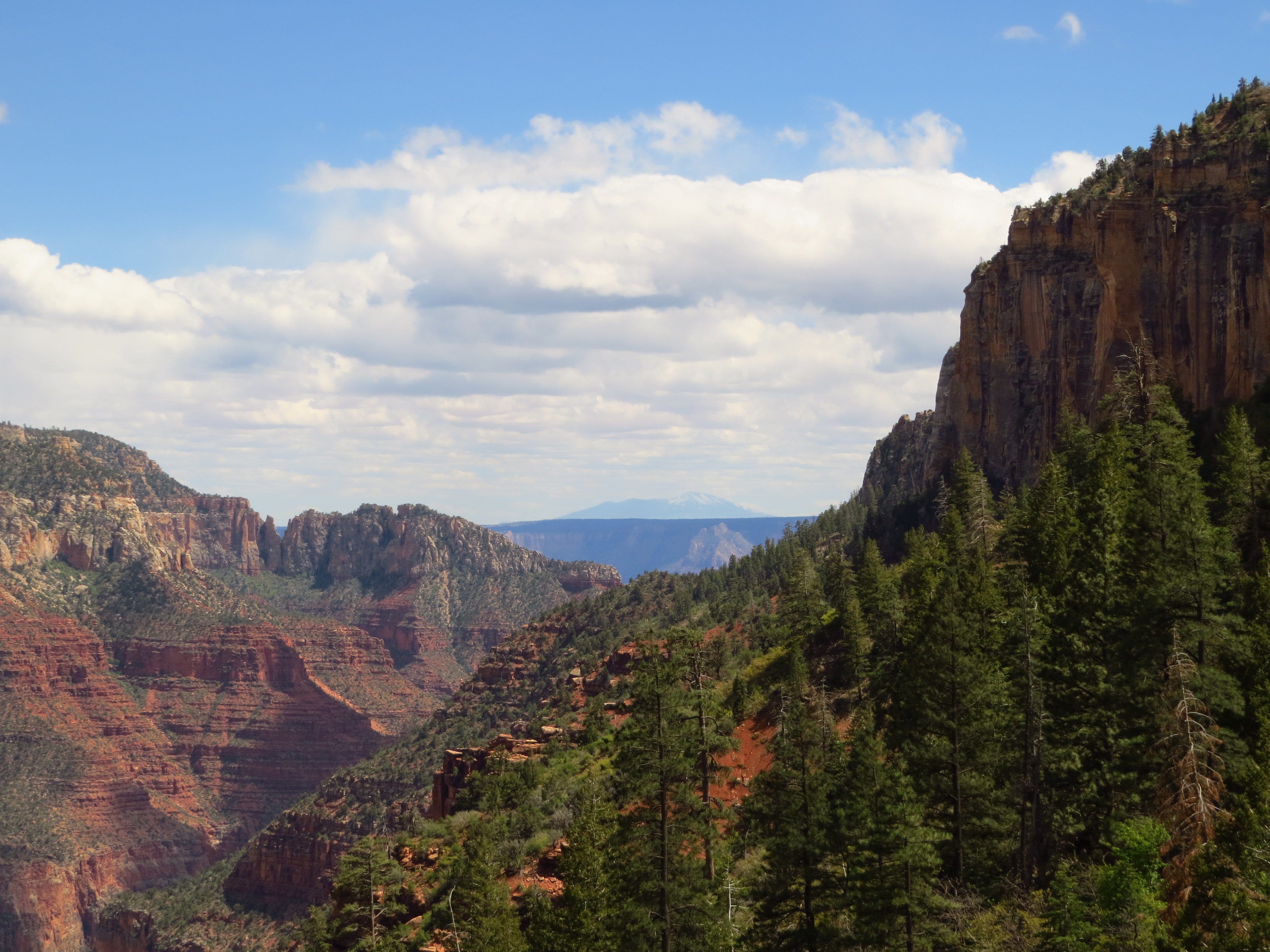
When Humphrey's peak appeared in the distance, there was a lot more snow there.
And when I reached the North Rim, there were still pockets of snow in the shade.
According to my tracker, 8.2 miles (including detour to Roaring Springs), 4172 feet of climb, 8:17 leisurely hours. Speed demon.
When I got to the campground, the two older men who'd left 10 minutes before me were already there, relaxing, their camp all set up at the campsite with the best view. They'd been there for almost three hours. :) They were super friendly and we talked gear and such and they invited me to their bonfire party later.

The campground (and the entire North Rim) was still closed to visitors (except those who had walked or biked there), so it felt like we had the whole place to ourselves. I chatted with a pair of young women who had also made it before me. Then I chatted with others as they drifted in--my big group of trail friends and another pair of young women I'd met the night before at Cottonwood. The guys lit a fire, and we all hung out and watched the sunset.
I was the last one to bed. At 8:25.
Wonderful, wonderful day.
See my posts on Day 1: South Rim to Cottonwood


